



The end of SEO as we knew it
For two decades, SEO consisted of deciphering Google’s ranking algorithms based on links and keywords. However, in 2026, the landscape has mutated to GEO (Generative Engine Optimization). Today, success is not only measured by appearing on page one, but by being the trusted source that generative engines use to build their answers.
The GEO guide in 6 points
If your content is not able to be synthesized by an AI, your organic visibility tends to zero. In this post, we analyze how technical and semantic evolution is redefining web traffic.
1. What is GEO and why is it the new standard?
GEO is the logical evolution of SEO in a world where the user does not want to navigate through ten tabs, but to get a direct, comparative and verified answer. While traditional SEO sought to optimize for the “crawler”, GEO optimizes for the “reasoner”.
Response engines (Google Gemini, Perplexity, OpenAI Search) work by retrieving information that is then processed. To rank here, content must have an atomic data structure: information that can be fragmented and reassembled without losing context and authorship.
2. The three pillars of technical GEO
Although SEO and GEO often overlap, they have some particularities, discover them.
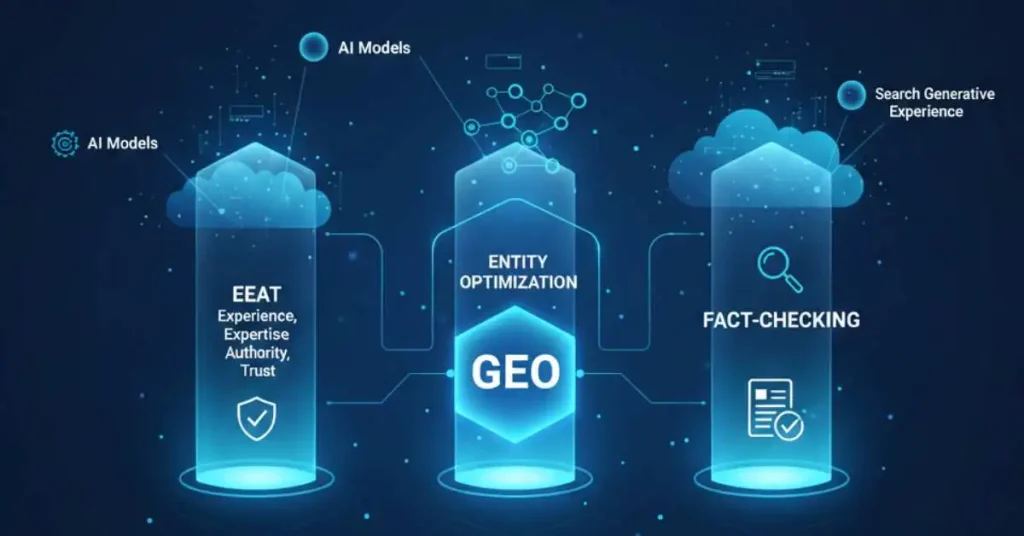
A. Citability and Verifiability (The Fact-Check Factor)
In 2026, AI has an obsession: to avoid hallucinations. Therefore, it prioritizes content that offers verifiable data.
- Use of primary sources: The algorithm penalizes rehashed content. If you provide data from your own study or unique field experience, your Citability Score increases.
- High authority external references: Linking to official institutions or academic databases is no longer optional; it is the sign that your information is safe to be shown to the user.
B. Entity and N-gram Optimization
We no longer optimize for “buy sneakers”, but for the entity “Performance sports footwear”. GEO understands the relationships between concepts. A technical post must cover the entire knowledge network of a topic to be considered an authority. This implies using rich semantics that connect your main topic to adjacent subtopics in a logical way.
C. Micro-formatting and Schema Org 2026
The code behind the text is more relevant than ever. The use of advanced JSON-LD makes it possible to tell the AI exactly who wrote the text, what experience they have (via links to LinkedIn or scientific profiles) and which parts of the text are “key findings.”
3. The evolution of the EEAT: From content to reputation
The acronym EEAT (Expertise, Expertise, Authority and Trust) has gone up a notch. In the age of generative AI, massively machine-created content has saturated the web. How does an expert differentiate?
- First-hand experience: AI looks for signs of “humanness”. Phrases like “In our lab tests in 2025 we detected that…” carry more weight than a generic explanation.
- Verified authorship: Google uses the author’s digital identity as a ranking factor. An article written by a recognized entity in its field is 80% more likely to appear in the “AIGS” (AI Generated Snapshots).
4. Tactical strategies to master the GEO
The Semantic Chunking Method
Divide your post into sections that respond to the “5 W’s” (Who, What, Where, When, When, Why). Each section should be a separate block of knowledge. This makes it easier for the AI to “snip” your paragraph and insert it directly into a chat response, keeping the link to your website as the source.
Optimization of “Response Intent”.
Instead of focusing on search volume, focus on query resolution. The 2026 algorithm rewards brevity in direct answers and depth in technical explanations. If a user asks “How to set up a GEO environment?”, your post should provide the immediate technical answer, followed by the in-depth analysis.
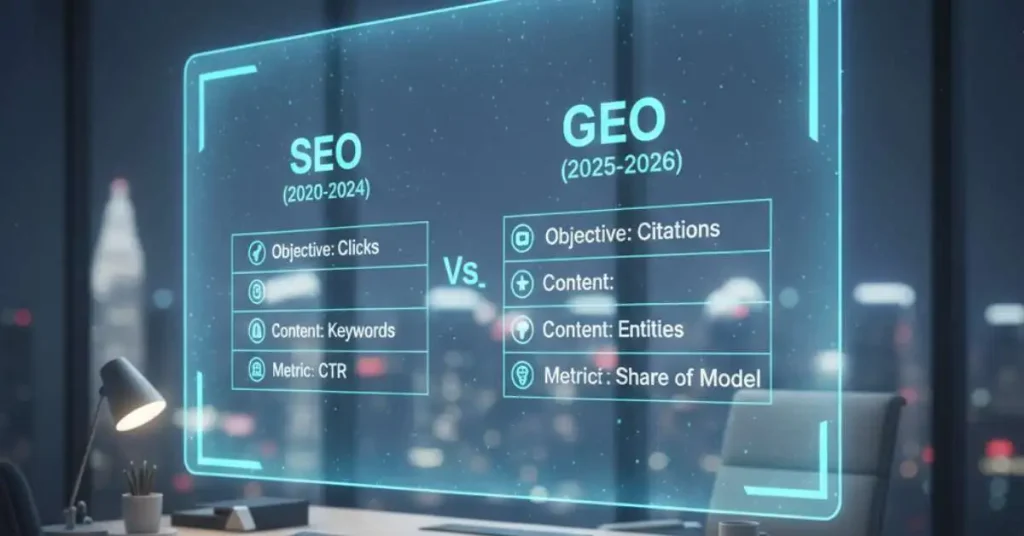
5. Technical comparison: The paradigm shift
| Success Factor | SEO (2020-2024) | GEO (2025-2026) |
| Architecture | Hierarchical silos | Knowledge networks (Mesh) |
| Key words | Long tail and exact | Dialogue intentions and entities |
| Backlinks | Quantity and relevance | Brand mentions and AI quotes |
| Content | Long-form (1500+ words) | Data-rich (Information density) |
6. The immediate future: GEO and voice/multimodal search
With the full integration of Gemini Live and wearable devices, positioning is no longer just textual. Technical GEO now includes multi-modal asset optimization. Your images must have deep descriptive metadata and your videos must be structured by chapters that AI can “read” and transcribe in real time for the user.
Search is no longer a text bar; it’s an ongoing conversation. If your content strategy is not conversational, technical and highly authoritative, you will be relegated to the secondary index of the web, that place where users no longer enter.
Conclusion
The evolution from organic positioning to technical GEO is not an option, it is a necessity for digital survival. Content creators must transform themselves into curators of verified knowledge.
Success in 2026 can be summed up in one phrase: “Don’t write so they can find you, write so AI can’t ignore you.” Technical authority and data transparency are your best tools to conquer the new Google ecosystem.
To remain competitive, organizations must prioritize three critical areas:
- Semantic Interoperability: Implement data schemas that allow IAs to map complex relationships between author, content and empirical evidence.
- Information Noise Reduction: Eliminate superfluous content to concentrate value on chunks of information with high data load and low entropy.
- Verifiable Source Authority: Strengthen the profile of authors through the digital identity protocol, ensuring that the EEAT is traceable outside the own domain.
In short, modern organic SEO is an exercise in prompts engineering on a grand scale. Those who manage to structure their knowledge so that it is easily “digestible” and “citable” by language models will not only dominate today’s searches, but will become the cognitive infrastructure upon which the web of the future will be built.

Marketing tecnológico en vena. Fanático de las tecnologías Martech que rompen moldes: IA generativa, blockchain, no-code, metaverso, automatización extrema… Convencido de que el futuro no se espera, se construye (y se vende muy bien).
Responsable del marketing más disruptivo y tecnológico.