

Estimated reading time: 7 minutes
Companies that centralize their data in an ERP increase their operational efficiency by 45%? However, the pain for many marketing managers remains the same: a powerful but poorly configured tool.
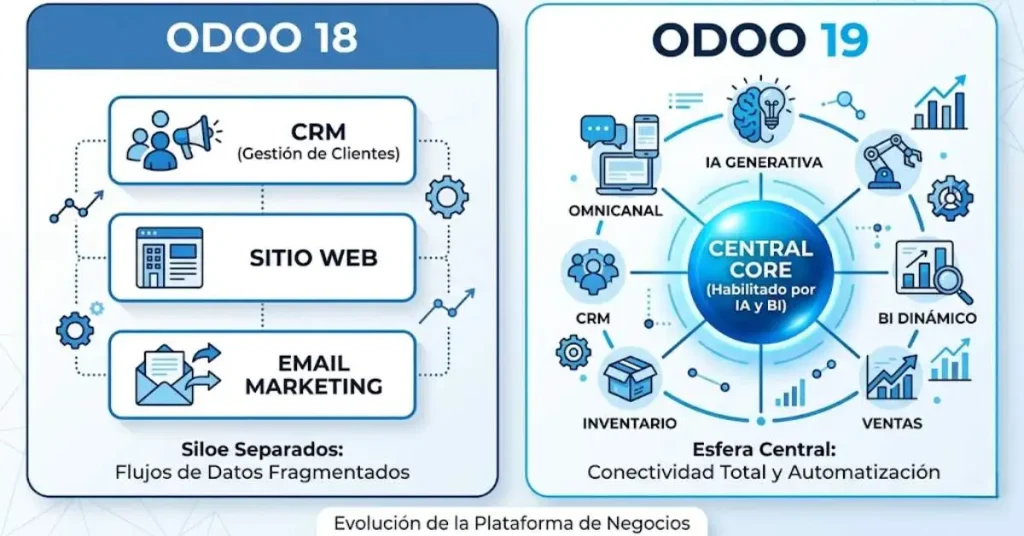
If you feel you are underutilizing your platform, this is the ultimate guide. Odoo 19 has arrived to break down the silos between sales and marketing, connecting entities such as customers, inventory and digital behavior in a single ecosystem.
Why is Odoo 19 the engine of Marketing in 2026?
In today’s landscape, Large Language Models (LLMs) and semantic search rule. Odoo 19 is not just a management software; it is an infrastructure designed to feed generative AI with accurate data from your business.
- Total Integration: From CRM to accounting.
- Part One Data: Crucial in the post-cookie era.
- Scalability: Ideal for both SMEs and large corporations.
Market context and the evolution of Marketing in 2026
In a digital ecosystem where generative artificial intelligence and cookie-less search redefine the rules of the game, a company’s ability to operate with unified, real-time data becomes its key competitive advantage. 2026 demands more than segmented campaigns; it demands seamless orchestration between customer experience, commercial operations and financial traceability.
This is where Odoo 19 is no longer perceived as a simple ERP, but as the central nervous system of modern business. The real disruption lies not only in the tools it incorporates, but in its “one source of truth” philosophy, a principle that marketing managers should leverage to build sustainable and scalable strategies, far from the technological fragmentation that drains budgets and efficiency.
Top 10 Critical Marketing Configurations in Odoo 19
Synchronization of the Customer Data Platform (CDP)
The basis of all success is data. Configure the contacts module to act as a centralized CDP. Make sure to correctly map every user interaction on your website directly to their customer record.
Data quality and the native CDP
Beyond the ten critical configurations, the success of Odoo 19 in marketing rests on a silent but fundamental pillar: data hygiene and governance. Unlike outsourced integrations that suffer from latency or data loss, Odoo 19’s contact module acts as a true transactional Customer Data Platform (CDP).
This means that it not only stores the user’s digital behavior (clicks, visits), but also enriches it with their purchase history, post-sale incidents and payment patterns.
For the marketer, this translates into the ability to launch hyper-personalized campaigns based on the customer’s actual Lifetime Value rather than guesswork, a level of accuracy that isolated marketing platforms simply cannot match.
2. Omni-channel Flow Automation
Don’t limit yourself to email. In Odoo 19, you can set up triggers that trigger SMS, push notifications or even WhatsApp messages based on shopping cart behavior or visits to specific pages.
Workflow intelligence
Omnichannel flow automation in Odoo 19 introduces a paradigm shift from scheduled automation to predictive automation.
Setting a trigger for an abandoned cart is standard; the real mastery comes when the system, thanks to the integrated AI engine, decides the optimal time and channel to intervene without predefined rules by the user. For example, the system can discern that a customer with high digital affinity responds better to an immediate push notification, while a more corporate profile requires a follow-up email 24 hours later, complemented by a WhatsApp message.
This intelligent orchestration capability, which learns from historical conversions, is what maximizes ROI and minimizes customer fatigue, turning omnichannel theory into a profitable operational reality.
3. On-Page SEO Optimization from the Web Module
Take advantage of native tools to manage metadata, heading structures (H1-H4) and the new automatic Schema Markup generator that facilitates reading by engines such as Google SGE.
4. Advanced Integration with Social Networks and Ads
Connect your Meta Ads and Google Ads accounts. The key here is the Conversion API (CAPI), which allows Odoo to send offline sales data back to the advertising platforms to optimize ROI.
5. Predictive Lead Scoring (AI) Configuration
Use Odoo’s AI engine to assign points to your leads. Set up “success” parameters based on historical closings so that your sales team focuses only on the prospects with the highest probability of conversion.
6. Dynamic Personalization of Content (Smart Content)
Display different banners and offers according to the visitor’s segment. If a customer has already purchased shoes, Odoo 19 allows you to show related accessories automatically on his next visit.
7. Email Marketing 2.0 campaign management
Set up A/B testing in a systematic way. The new interface allows you to preview how LLMs will see your content if the user uses voice assistants to read their emails.
8. Multi-touch sales attribution
Don’t give all the credit to the last click. Set up the attribution model in marketing reports to understand which blog posts or social media ads initiated the customer journey.
9. Configuration of events and integrated webinars
Centralize registration and tracking. Be sure to enable synchronization with the calendar and ticketing system so that the marketing flow does not break down after registration.
10. Real-time BI Dashboards
Customize your dashboard. Include LTV (Lifetime Value) and CAC (Cost of Acquisition) metrics. What you don’t measure, you can’t improve.
Table: Odoo 18 vs Odoo 19 in Marketing
| Feature | Odoo 18 | Odoo 19 (2026) |
| AI engine | Basic / Predictive | Generative and Integrated |
| SEO | Manual | Automated with SGE focus |
| Channels | Email / SMS | Real Omni-channel (incl. WhatsApp) |
| Analytics | Fixed dashboards | Dynamic BI with natural language |
Conclusion
Implementing these 10 configurations in Odoo 19 is not an option, it is a necessity for any brand that wants to lead its industry in 2026. Efficiency and personalization are the keys to the new digital marketing.
Not if you have a clean database. Odoo offers advanced import tools, although expert consulting is recommended for process mapping.
Through the technical generation of clean sitemaps, redirection management and, above all, an optimized loading speed (Core Web Vitals) that Google prioritizes in 2026.
Yes, it is possible, but the trend in 2026 is unification. Using the native Odoo module avoids data loss and improves the coherence of the strategy.
Fully. Includes advanced privacy settings and consent management (cookies/GDPR) integrated in all data capture modules.
Odoo operates under a per-user subscription model that includes all applications, which makes it very competitive with stand-alone marketing suites.
Implementing Odoo 19’s advanced configurations not only transforms the company’s technology, but also redefines the role of the marketing team. By freeing himself from the tedious task of reconciling databases and managing disconnected tools, the marketing manager can move up the value chain to become an “experience architect”.
With real-time BI dashboards that unify financial (CAC, LTV) and behavioral metrics, decision making becomes strategic and auditable. The question is no longer “how do I set up this campaign”, but “how do I design a customer journey so seamless and relevant that conversion is a natural consequence”.
In this new scenario, Odoo 19 becomes the enabler that allows brands not only to sell more, but to build lasting relationships based on trust and relevance.
Which of these configurations do you think will impact your business the most this year? Tell us in the comments.
Do you need help to get the most out of Odoo? Visit our Odoo Consulting services section and transform your strategy today.

Marketing tecnológico en vena. Fanático de las tecnologías Martech que rompen moldes: IA generativa, blockchain, no-code, metaverso, automatización extrema… Convencido de que el futuro no se espera, se construye (y se vende muy bien).
Responsable del marketing más disruptivo y tecnológico.