



One of the most costly mistakes in B2B marketing and advanced services is treating a website redesign as a visual design project rather than a business engineering initiative.
The pattern is usually the same: a company approves a substantial budget to revamp its digital presence, hires an agency focused exclusively on graphic design, and months later launches a sleek website with sophisticated animations and high-definition images. However, three months after the launch, the traffic isn’t converting, the sales teams continue to report a lack of qualified leads, and the bounce rate for paid traffic is alarming.
A modern corporate website is not just an online institutional catalog—it’s the primary point of friction or acceleration in the sales pipeline. If the technical architecture and user experience aren’t designed to facilitate the purchase decision, the website acts as a drain where the investment generated by paid media and SEO is wasted.
From Digital Brochure to Revenue Generator
Traditional web development tends to focus on the question: “How do we present the company in an appealing way?” In contrast, a website designed as a revenue engine is built around a different question: “How do we reduce cognitive friction so that a qualified decision-maker immediately moves toward a sales conversation?”
| Dimension | Traditional Web Approach (Brochure) | Revenue Engine Web Approach (Inprofit) |
| Success Metrics | Design awards, impressions, time on site. | Business opportunities generated (pipeline), conversion rate, and cycle speed. |
| Information Architecture | Internal organizational chart (“About Us,” “Mission and Vision”). | Customer pain points, solutions by use case, and tangible proof of value. |
| Service Pages | Generic descriptive blocks without contextual calls to action. | Landing pages structured using CRO frameworks, comparison tools, and ROI calculators. |
| Touchpoints | A static contact form that is identical across the entire website. | Real-time direct scheduling integrated with CRM and progressive scoring. |
| Technical performance | Visual script overload and slow performance on mobile devices. | Strict optimization of Core Web Vitals and server-side tracking. |
The 7 Architectural Flaws That Are Holding Back Your Website’s Conversion Rate
Through technical audits and conversion analyses of B2B companies, we consistently identify seven structural flaws that hinder business performance:
1. Lack of an architecture geared toward purchase intent (Buyer Enablement)
Most corporate websites force users to navigate through multiple menus to find out what the company does, who its solution is for, and how much it costs to implement. In complex B2B cycles, between 70% and 80% of the preliminary research is conducted independently by the buyer before speaking with a sales representative.
- The problem: Menus overloaded with superficial options and a lack of pages dedicated to addressing common objections (direct comparisons, technical specifications, or integrations).
- The fix: Design navigation paths based on roles and use cases (By Industry, By Challenge, or By Executive Position), allowing users to find the technical answer in fewer than two clicks.
2. Messaging Focused on Features Rather Than Economic Value
The headlines on many corporate websites are full of abstractions: “Leaders in disruptive innovation” or “We’re transforming the future of your business.” This language does not address the priorities of a CEO or CFO.
- The mistake: Product pages that list technical features without linking each feature to its impact on costs, revenue, or risk mitigation.
- The fix: Apply conversion-oriented copywriting frameworks. Each content block should answer: What critical problem are we solving? How do we solve it differently from our competitors? And what is the empirical evidence (metrics, certifications, or verifiable testimonials) that it works?
3. Significant friction in data entry forms
The classic form with ten required fields (first name, last name, job title, company, number of employees, revenue, phone number, country, budget, and open message) drives down conversion rates, especially for traffic coming from mobile devices or advertising campaigns.
- The mistake: Treating the form like a police interrogation that shifts the burden of proof to the user.
- The fix: Implementmulti-step forms, automatic enrichment of corporate data via email domains, and embedded direct scheduling tools (connected to HubSpot, Salesforce, or Odoo). If a qualified user wants a meeting, they should be able to choose a date and time right then and there.
4. Deterioration of Core Web Vitals Due to Script Overload
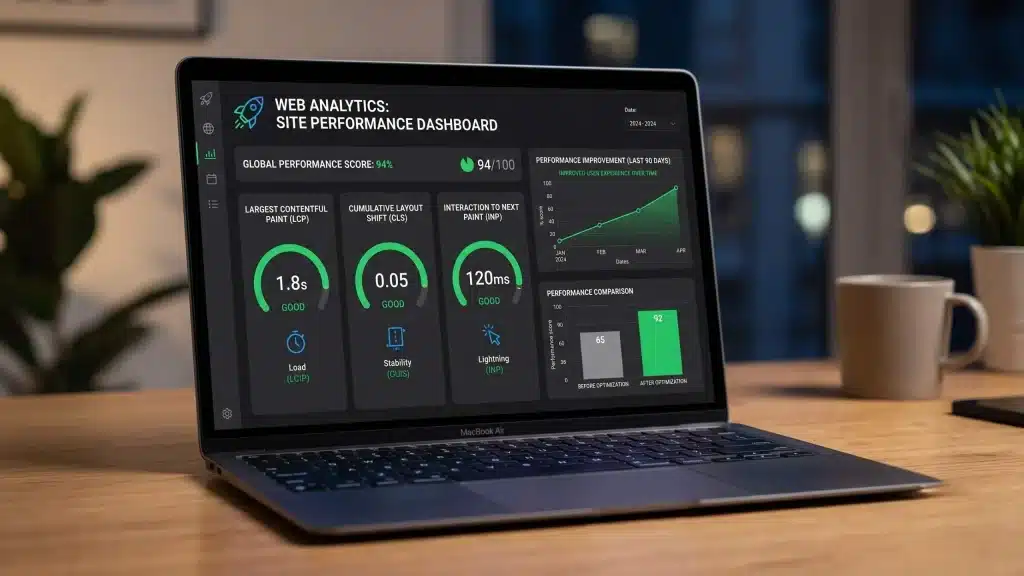
Every tracking pixel installed in the user’s browser, every visual effects plugin, and every unnecessary animation library slows down the site.
- The issue: A website with a Largest Contentful Paint (LCP) of more than 3 seconds or with visual shifts during loading (high CLS).
- The fix: Every second of loading delay reduces conversion rates by 7% to 15%. Optimizing website architecture requires a thorough cleanup of client-side scripts, migration to efficient rendering (JAMstack, headless CMS, or ultra-lightweight WordPress/PHP architectures without bloated dependencies), and server-side tag management (Server-Side GTM).
5. Genericlanding pagesthat aren’t connected to paid media
A common mistake is directing paid traffic from targeted Google Ads or LinkedIn Ads campaigns to thehomepage or to a generic product section.
- The issue: A mismatch between the ad’s promise and the content visible within the first three seconds of browsing the website.
- The fix: The site’s architecture must support the agile generation of modular templates tailored to specific campaigns. If the ad promised a software comparison for the logistics sector, the landing page must reflect that exact message in the main headline, eliminating distracting menus.
6. Technical Disconnect Between Website Behavior and the CRM
When a user completes an action on the website, the system often simply sends an email notification to a generic departmental inbox.
- The issue: No traceability of the user’s previous browsing history in their customer profile and delays in sales assignment.
- The fix: The web architecture must communicate with the corporate CRM via secure APIs and webhooks. When a lead is entered, the system must record which pages the user visited before converting, which technical document they downloaded, and which channel originally brought them in, triggering instant notifications to the assigned sales team.
7. Lack of micro-conversions for early-stage buyers
Not all qualified visitors who land on your website are ready to request a quote today. If the only call to action is “Request a Demo” or “Sign Up,” you’ll lose 90% of users who are still in the evaluation and education phase.
- The flaw: A binary conversion model—either the user requests a sales meeting or leaves without a trace.
- The fix: Design high-value secondary conversion points: self-diagnostic tools, interactive financial impact calculators, access to confidential technical documentation, or in-depth case studies. This allows you to capture the contact, assign a score (lead scoring), and nurture them automatically until they reach buying maturity.
How to Determine Whether Your Website Is a Cost Center or a Sales Driver
To assess the current state of your website infrastructure, review the following key metrics in your business analytics:
[ Tasa de conversión a Lead ] ──► Meta B2B saludable: > 2,5% - 5%
[ Tiempo de carga en móvil ]  ──► Umbral crítico: < 2,2 segundos (LCP)
[ Contacto a oportunidad ]   ──► Eficiencia del pipeline: > 25% SQL/MQL
If your metrics fall significantly below these thresholds, the problem rarely lies in traffic volume—it stems from architectural friction and a lack of conversion-oriented design.
Turn your digital presence into a competitive advantage
Having a visually appealing website is a basic requirement, but it’s far from enough. In a competitive market, your website must act as your most efficient sales consultant: available 24 hours a day, explaining your value proposition with complete technical clarity, and removing any barriers between the customer’s interest and closing the deal.
At Inprofit, we develop web infrastructures designed from the very beginning to drive business. We combine software engineering, technical optimization of Core Web Vitals, CRO architecture, and native integration with your MarTech and CRM stack.
If you want to pinpoint exactly which elements of your website are hindering your traffic conversion and learn how to turn it into a predictable lead generation channel, contact our team to request a technical and conversion audit of your corporate website.

Marketing tecnológico en vena. Fanático de las tecnologías Martech que rompen moldes: IA generativa, blockchain, no-code, metaverso, automatización extrema… Convencido de que el futuro no se espera, se construye (y se vende muy bien).
Responsable del marketing más disruptivo y tecnológico.