


In today’s digital ecosystem, the question is no longer whether to use AI, but where to delegate and where to lead. With the consolidation of GEO (Generative Engine Optimization), Google and other engines prioritize content that demonstrates a real human experience over the saturation of generic synthetic texts.
High-impact areas: Where AI is your best ally
AI excels in managing large volumes of data and personalization at scale. These are the areas where its use guarantees a competitive advantage:
A. Predictive analytics and big data
AI can process behavioral patterns that the human eye ignores.
- Use: Churn rate prediction and attribution modeling.
- Result: Preventive campaigns before the user decides to leave.
B. Hyper-Personalization of the Experience (UX).
In 2026, “segmented” marketing is dead; it is now individualized. The application of hyper-personalization tools does not allow:
- Use: Agentic chatbots that solve complex problems and dynamic product feeds in real time.
- Benefit: Increased conversion rate through absolute relevance.
C. Technical optimization and SEO of structure
- Usage: Structured data generation (Schema Markup), real-time 404 error detection andcrawl budget optimization.
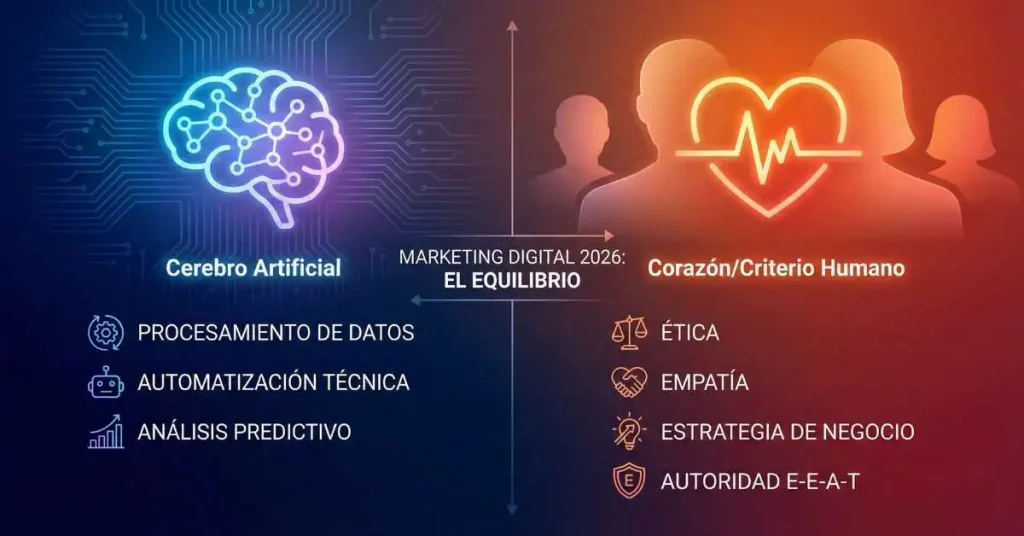
The “red zones”: Where you should NOT use AI (or limit it)
Google’s 2026 algorithm detects “empty content”. If AI does everything, your authority disappears.
A. Creation of business strategy
AI is great at executing, but blind at planning. It doesn’t know your long-term vision, your ethical values or the nuances of your local competition that are not in its database.
B. E-E-A-T: Opinions and firsthand experience
Google penalizes content that lacks “Information Gain” (original added value).
- Risk: An AI cannot “try” a product or “feel” a service.
- Solution: AI can summarize, but expert opinion must be human to maintain reliability(Trust).
C. Ethics, Privacy and Human Empathy
In situations of reputation crisis or sensitive customer service, the use of AI can be perceived as cold and dehumanizing, irreversibly damaging brand loyalty.
Comparison: Human vs. AI in Marketing 2026
| Marketing Area | IA Leadership | Human Intervention |
| Copywriting | Drafts and variants of advertisements. | Final editing, brand tone and emotion. |
| SEO / GEO | Technical structure and keywords. | Authorship, success stories and own data. |
| Advertising | Automatic bidding and segmentation. | Definition of objectives and data ethics. |
| Analysis | Metrics processing. | Decision making and context interpretation. |
In conclusion Yes or no?
The integration of Artificial Intelligence in marketing in 2026 must be executed under a hybrid architecture model, where AI acts as a natural language processing (NLP) and predictive analytics engine, but always under the governance of human judgment.
From a technical perspective, success lies in delegating high-computing tasks, such as structured data tagging or dynamic hyper-personalization, to free up the creative bandwidth needed to build a coherent and ethical brand narrative.
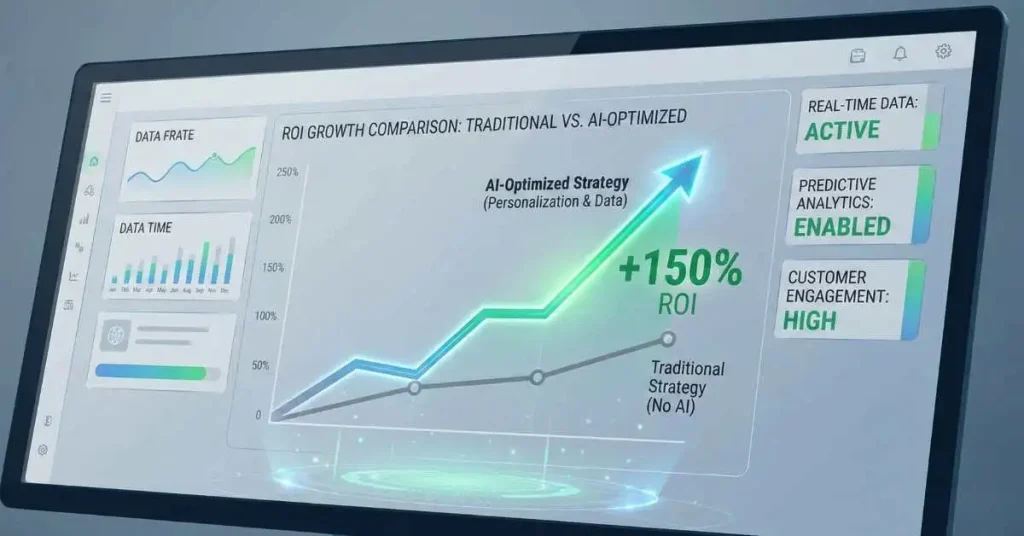
To maximize positioning in generative engines(GEO), it is imperative that companies do not use AI to replicate existing information, but to synthesize their ownfirst-party data (First-Party Data).
The current algorithm prioritizes Information Gain; therefore, AI must be the instrument that formats and distributes knowledge, while the differential value – expert opinions, real case studies and strategic vision – must be verifiable human authored to satisfy the E-E-A-T pillars.
Ultimately, the determining factor will be citable. A technical post that clearly delineates where automation should not intervene projects superior reliability in the eyes of Google.
Does your marketing strategy survive the algorithm or dominate it?
Artificial Intelligence has democratized the tools, but it has eliticized the strategy. In an environment saturated with synthetic content, the difference between being invisible and being a benchmark is the human factor you apply to your data.
At Inprofit, we don’t just “install AI”. We design the Hybrid Architecture that your business needs for the 2026 scenario: we automate the operational so that your team (and ours) can focus on what really generates profitability: strategy, creativity and real connection with your customer.
Don’t let your brand be just one more in the sea of automation. Contact us now.

Especialista en SEO y Paid Media | Google Ads, Meta Ads, LinkedIn Ads & Search Console en vena Optimizo visibilidad orgánica + escalo adquisición pagada con ROAS obsesivo y estrategias data-driven.
Especialista en Performance Digital, Core Web Vitals, E-E-A-T, algoritmos de subasta, attribution multi-touch y maximizar LTV/CAC.