



When a purchasing manager of a medium-sized company types in ChatGPT “what marketing automation tool do you recommend for B2B companies in Spain?”, the AI responds with specific names. Some of those names are your competitors. Yours, probably, isn’t. GEO marketing B2B -Generative Engine Optimization- is the discipline that determines who appears in those answers and who remains invisible. It’s not a fad: according to Forrester, 89% of B2B buyers already use generative AI as a primary source of information at some stage of their buying process. The question isn’t whether your customers use these tools. It’s whether they find you when they use them.
Why classic SEO is no longer enough for the B2B buyer of 2026
For fifteen years, the goal of SEO was clear: to appear in the first results of Google. The buyer clicked, came to your website and the journey began. That model is breaking down at an accelerated rate.
By 2026, more than 60% of searches trigger some type of AI-generated response before the user sees a traditional result. The B2B buyer-with little time, high demand and access to powerful tools-gets a synthesized answer directly from ChatGPT or Perplexity, evaluates the options AI presents and, in many cases, shortens the decision process without visiting any website.
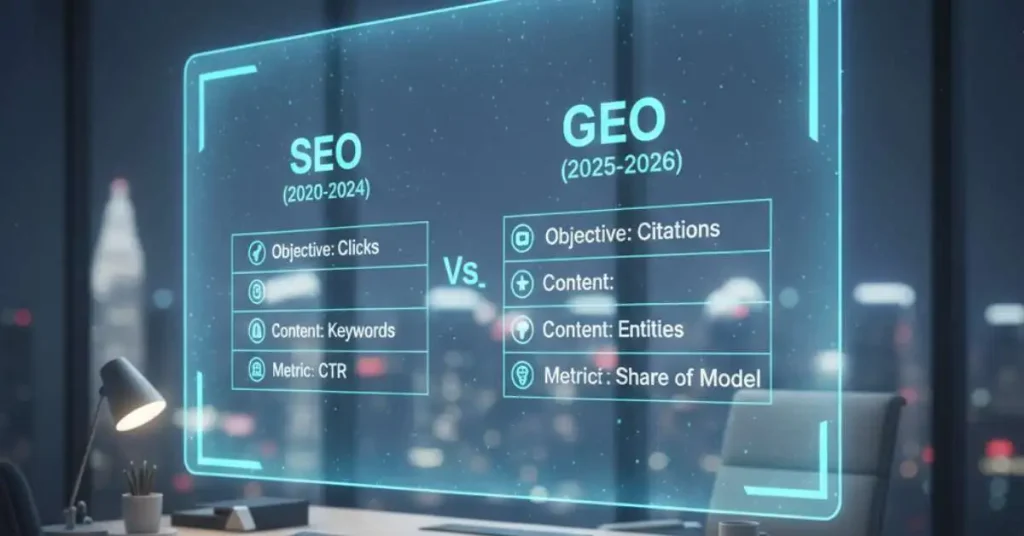
The difference between SEO and GEO is structural:
| Traditional SEO | GEO (Generative Engine Optimization) |
|---|---|
| Positioning pages in a results ranking | Be quoted within an AI response |
| The user clicks and arrives at your website | AI recommends your brand even if there is no click |
| Key metrics: position and organic traffic | Key metric: frequency of mention in IA responses |
| Main signal: backlinks and domain authority | Main signal: semantic structure, citations, original data |
| Optimization for Googlebot | Optimization for GPTBot, PerplexityBot, ClaudeBot |
They are complementary, not exclusive. But the mistake most B2B companies make is to assume that good SEO guarantees visibility in AI engines. It doesn’t.
How an AI “thinks” when asked a question by a B2B buyer
The language models – ChatGPT, Perplexity, Google AI Overviews – select their sources following a specific logic that is far from Google’s algorithm. They do not measure domain authority alone. They evaluate the content’s ability to answer a specific question with accuracy, context and credibility.
Four factors determine whether your content enters an AI’s response:
- Exact semantic relevance. The AI extracts snippets that directly answer the question. Content that circles around before getting to the point is less likely to be extracted.
- Freshness of the content. An article from 2022 without updates has little chance of being cited in 2026 even if the content is still valid. Regular updating is a sign of reliability.
- Density of verifiable evidence. Explicitly sourced data, concrete statistics and references to recognized studies significantly increase the likelihood of citation. Research from Georgia Tech and Princeton concludes that including verifiable statistics can increase visibility in generative responses by up to 40%.
- Structure that facilitates parsing. Logical heading hierarchy (H1 → H2 → H3), short paragraphs and self-contained definitions allow RAG (Retrieval-Augmented Generation) systems to extract and process your content more efficiently.
The 5 signs that get your content cited by IAs
Not all techniques carry the same weight. Based on the available research on generative model behavior, these are the five signals with the greatest real impact on GEO B2B marketing:
1. Direct definition in the first 50 words
Information retrieval systems prioritize content that responds immediately. If your article on marketing automation takes 400 words to define what it is, the AI discards it as a source in favor of one that makes it clear in the first paragraph.
2. Statistics with explicit attribution
Writing “according to Forrester, 89% of B2B buyers use AI in their buying process” is infinitely more quotable than “many buyers already use artificial intelligence.” LLMs are trained to prioritize content with quantifiable, attributed evidence.
3. Coherent and semantic H1/H2/H3 structure.
Headings are not just for the reader. They are the map that models use to understand what each section is about. An H2 that says “Enterprise Solutions” provides less of a signal than one that says “How to shorten the B2B sales cycle with automation.”
4. Citations to external sources of authority
Paradoxically, linking to Forrester, Gartner or Harvard Business Review increases your credibility with AI engines. Content that cites outside sources projects editorial credibility; content that doesn’t cite anything looks like unsupported opinion.
5. Original or proprietary data
If your company publishes proprietary benchmarks, customer results or industry data analysis, you have the most difficult asset to replicate: unique information. Generative models mark this type of content as “high quality primary source”.
Case study: what happens when you ask Perplexity “best MarTech agency in Spain”.
Take the test right now. Open Perplexity and type in that question. The AI will respond with three or four names. The probability that one of those names is your company is directly proportional to whether you’ve applied GEO – and close to zero if you haven’t.
What do the companies that do appear have in common? Their content meets at least three of the five signals described above. They have articles that define key industry concepts, cite recognized studies, and are structured to facilitate AI extraction. They don’t necessarily have more traffic than you do. But their content is more “parseable.”
Traffic from AI engines converts at a rate 4.4 times higher than traditional organic traffic in B2B contexts. It’s not a volume channel: it’s a quality channel(GrowthMarshal / Semrush, 2026).
The strategic implication is clear: even with a low volume of mentions in IAs, the quality of leads coming in can be higher than those coming in organically. This makes GEO a business priority, not just a content marketing priority.
GEO Technical Checklist for B2B companies
Before working on the content, there is a technical layer that you can’t ignore. These are the critical points:
- robots.txt open for AI bots. Check that GPTBot, PerplexityBot and ClaudeBot are not blocked. If they are, no generative engine can index your content.
- Schema markup of B2B services. Implement Organization, Service and FAQPage as a minimum. Pages with full Schema are 3.7 times more likely to be cited in generative responses.
- Core Web Vitals. A slow site generates a negative signal also for AI crawlers. LCP below 2.5 seconds is the minimum threshold.
- HTTPS and clean content architecture. Descriptive URLs, without unnecessary parameters, with logical hierarchy of categories.
- llms.txt: useful but not urgent. This file – the equivalent of robots.txt but for language models – still has less than 11% adoption and current data shows no significant correlation with citation frequency. It is worth implementing, but not as a first priority.
GEO on LinkedIn: the channel that AIs also listen to
Language models don’t just learn from websites. They learn from content published on networks with a high density of sector information. LinkedIn is, in this sense, a GEO channel of the first order for B2B companies.
When you publish an article on LinkedIn about automation trends with your own data and verifiable references, you are feeding the data ecosystem from which the models feed. Not directly – LLMs do not index LinkedIn in real time – but through the authority and mentions that content generates in other media that are tracked.
The practical strategy: publish on LinkedIn the same key concepts, definitions and statistics that you optimize on your blog. Semantic coherence between what you say on networks and what you say on your website reinforces the perception of your brand’s sectoral authority in the eyes of generative systems.
90-day GEO roadmap for B2B agencies and consultancies
Time needed: 90 days
- Days 1-30 – Audit and technical basis.
Check your robots.txt for AI bots. Implement or complete the Schema markup of services. Identify the 10-15 blog articles with the most organic traffic and evaluate how many meet the 5 GEO signals. Update the dates and add recent data to those that do not.
- Days 31-60 – GEO-first content production.
Write three or four new articles designed from scratch with semantic structure optimized for IA: direct definition in first 50 words, data with source, H2 with real questions from buyers, FAQ section. Prioritize topics where there is clear commercial intent: comparisons, “best tool for X”, “how to do Y in company”.
- Days 61-90 – Measurement and adjustment.
Perform systematic manual tests in ChatGPT, Perplexity and Google AI Overviews with the questions your ideal customer would ask. Document whether you appear and in what position. If you still don’t appear, identify which sources the AI cites and analyze what makes that content different.
Tools to find out if you appear in AI responses
The GEO measurement ecosystem is still maturing, but there are already functional options:
- Manual testing. The most reliable and free. Create a bank of 20-30 questions your ideal customer would ask an AI and search ChatGPT, Perplexity, Gemini and Claude on a weekly basis. Record the results in a spreadsheet.
- Semrush AI Toolkit. Monitor brand mentions in generative engine responses. Expanding functionality during 2026.
- BrightEdge Generative Parser. Aimed at enterprise content teams, it allows you to analyze which fragments of your pages are being extracted by generative systems.
- Referral analysis in GA4. Shortcuts from ChatGPT or Perplexity already appear as traffic sources in Google Analytics 4. Filtering by “chat.openai.com” or “perplexity.ai” gives you a first real visibility metric.
Frequently asked questions about GEO marketing B2B
No. SEO is still the foundation: without domain authority and technically sound content, GEO doesn’t work. They are layers of the same building, not alternative strategies.
Improvements in Perplexity and Google AI Overviews are seen in four to eight weeks. ChatGPT has a longer update cycle but considerably higher user volume.
It works especially well for niche B2B companies. A consulting firm specializing in a particular industry is more likely to be cited as a reference in that niche than a generalist agency, as long as its content is well structured. GEO levels the field against larger brands that produce generic content.
If your goal is to appear in AI responses, you must allow access. Blocking GPTBot in robots.txt prevents OpenAI from indexing your content. The only reason to block it is if you have proprietary content that you don’t want to be used to train models.
B2B GEO marketing is not the future: it is the present of how your prospects research before they buy. Companies that implement it today will have a significant positioning advantage in a channel that is still undersaturated. Those that wait for it to become standard will be competing in a much more crowded space.
If you want to evaluate how your company is positioned in the main AI engines and what concrete changes to implement in your content strategy, let’s talk.

Especialista en SEO y Paid Media | Google Ads, Meta Ads, LinkedIn Ads & Search Console en vena Optimizo visibilidad orgánica + escalo adquisición pagada con ROAS obsesivo y estrategias data-driven.
Especialista en Performance Digital, Core Web Vitals, E-E-A-T, algoritmos de subasta, attribution multi-touch y maximizar LTV/CAC.