


80% of B2B buyers have already chosen their preferred supplier before talking to any sales rep. Gartner confirms it: the decision process happens silently, on Google, on LinkedIn, in ChatGPT responses. If your company doesn’t show up in that autonomous research phase, it simply doesn’t exist. A well-constructed B2B marketing plan solves exactly that problem: it ensures that your company is visible, relevant and credible when the buyer is searching, not when you decide to call them.
The challenge is not technology. The challenge is strategy. 95% of B2B companies already use or plan to use AI in marketing according to The Growth Syndicate, but only 19% have integrated these tools into their actual workflows. The result is predictable: investment without return.
This 8-phase framework is designed to change that.
- Diagnosis of the problem:
25% of the B2B marketing budget is spent on campaigns that do not generate pipeline. The source is almost always the same: a plan that exists as a document, not as a system.
- Audit with IA in 4 hours:
use ChatGPT or Claude with structured prompts to map your positioning, your ideal customer’s pain points and the opportunities your competitors have that you are not taking advantage of.
- ICP beyond the buyer persona:
defines three dimensions – company profile (firmographics), complete purchase committee and purchase triggers – so that each message reaches the right person at the right time.
- Channel selection with the B2B matrix:
LinkedIn Ads for tickets over 5.000€, Google Ads for high intent demand, SEO+GEO for sustained visibility, email for nurturing and ABM for strategic accounts over 20.000€.
- Structured budget:
growing B2B companies invest between 7% and 12% of their turnover in marketing (benchmark 2026, Data-Mania). The recommended distribution: 40% demand, 30% nurturing, 20% technology and 10% iteration.
- Minimum viable technological stack:
CRM (HubSpot or Odoo) + automation (n8n or Make) + analytics (GA4 + Looker Studio) + SEO/GEO (SE Ranking). Enough to execute and measure without a team of 20 people.
- Business KPIs:
replace impressions and likes with CAC, LTV, MQL→SQL conversion rate and pipeline generated by marketing in euros. These four numbers are the only ones that justify (or question) a budget before management.
- Quarterly review:
A marketing plan is not an annual document. It is a living system that is updated every three months with four questions: what channel worked, what to pause, whether the ICP has changed, and what the competition is doing that you are not yet doing.
But let’s look at the steps in detail.
1. The real problem: why most B2B marketing plans don’t generate pipeline.
Before building, it pays to diagnose. 25% of B2B marketing budgets are spent on campaigns that generate metrics but not revenue, according to Demand Gen Report 2026. And 56% of B2B marketers admit they find it impossible to connect their content efforts to bottom-line ROI.
The diagnosis is usually the same in all cases: the plan exists as a document but not as a system. It is defined in January, executed in a linear fashion and reviewed in December to check that the results did not arrive. The B2B market in 2026 does not work like that.
A B2Bdigital marketing plan that generates results is built on three pillars that most ignore: real diagnosis of the starting situation, ICP defined with surgical precision and KPIs connected to the sales pipeline, not impressions.
2. Pre-diagnosis: situation audit with IA in less than 4 hours
Before choosing channels or allocating budget, you need to know where you are. AI turns this process, which used to take a consultant weeks, into a half-day work session.
Use this sequence with ChatGPT or Claude to structure the initial diagnosis:
- Current positioning analysis: prompt – “Act as a B2B strategy consultant. Analyze [company/sector] and tell me: what differential value proposition does it have over [competitors]? In which search terms should it appear? Identify the top 3 positioning gaps.”
- Customer pain point map: prompt – “What are the top 5 operational and strategic problems of a [target position] in a company [size] in sector [X] in Spain in 2026?”
- Competitor analysis: consult Google Search Console to see in which keywords you are losing visibility against specific competitors. Complement with SE Ranking to detect the pages that generate the most traffic and that you do not have.
The output of these three consultations gives you, in less than four hours, the opportunity map on which to build the plan.
3. Defining the ideal B2B customer in 2026: the ICP goes beyond the buyer persona.
The buyer persona is a picture. The ICP (Ideal Customer Profile) is a signal of buying intent. In B2B, where the average buying committee includes between 6 and 10 people according to Gartner, the difference is critical.
A comprehensive B2B ICP for 2026 includes three dimensions that most overlook:
- Company profile (Firmographics): sector, size, turnover, technological tools already in use (the tech stack is a sign of digital maturity).
- Buying committee profile: who decides (CEO/CFO), who influences (operations or IT), who blocks (legal or management). Each profile needs a different message.
- Purchasing triggers: the events that trigger the search for a supplier. A CRM change, a financing round, the addition of a new sales manager, the loss of a key customer. These triggers are what turn generic content into content that converts.
Once the ICP is defined with these three dimensions, all channels, messages and formats are calibrated against it. Without this step, the rest of the plan is intuition.
4. Channel selection: the B2B matrix for 2026
There is no perfect channel for all B2B businesses. There is the right channel for your average ticket, your sales cycle and your ICP. This comparison table summarizes the main options:
| Channel | Best for | Speed of results | Recommended average ticket | Acquisition cost |
|---|---|---|---|---|
| LinkedIn Ads | Outreach to specific decision makers | Average (2-4 months) | > 5.000 € | High |
| SEO + GEO | Information demand, TOFU/MOFU | Slow (4-12 months) | Any ticket | Low to medium term |
| Google Ads (Search) | Demand for high intention | Fast (2-6 weeks) | > 1.000 € | Medium-high |
| Email Marketing + Nurturing | Existing database, retention | Quick | Any ticket | Very low |
| SEO + GEO content | Positioning in generative AI | Progressive | Any ticket | Under |
| ABM (Account-Based Marketing) | Defined strategic accounts | Half-long | > 20.000 € | High but efficient |
A note on ABM: account-based programs generate 2.6 times more pipeline per euro invested than broad demand generation, with 41% higher close rates and 33% higher deals, according to Demand Gen Report 2026. If your average ticket is over €15,000 per deal, ABM is not an advanced option: it’s the right choice.
As for the GEO channel – optimization for generative AI engines such as ChatGPT, Gemini or Perplexity – it is the emerging channel that most managers ignore and that in 2026 is no longer optional. If a prospect asks “what are the best marketing automation agencies in Spain” and your company does not appear in that answer, you are unknowingly losing visibility.
5. B2B marketing budget structure: how much and how to allocate it
Growing B2B companies spend between 7% and 12% of their revenue on marketing, according to Data-Mania’s 2026 benchmark. The industry median is 9.1% of revenue.
For a company with a turnover between 500.000€ and 2M€, a reasonable distribution of the marketing budget would be:
- 40% in demand generation (SEO, content, paid, GEO): attracts new prospects within the ICP.
- 30% in nurturing and conversion (email marketing, automations, landing pages): accelerate the sales cycle of those who already know you.
- 20% in technology and tools (CRM, automation, analytics): no stack, no scalability.
- 10% in testing and iteration (new channels, A/B testing, experiments): the market changes and the plan must change with it.
The most common mistake is not to spend too little, but to spend without a system. A budget of €50,000 well distributed generates more pipeline than one of €200,000 invested without prior diagnosis.
6. The minimum viable technological stack to execute the plan
Technology does not replace strategy, but without the right tools, strategy does not scale. For a growing B2B company, the minimum viable stack in 2026 includes four layers:
- CRM: HubSpot (ideal for integrated marketing and sales teams) or Odoo (if you need to connect it with operations and billing). Without CRM, there is no traceability between lead and revenue.
- Automation: n8n self-hosted for technically capable companies (maximum flexibility and zero licensing costs) or Make for less technical teams. Automation is what turns a marketing plan into a system, not a list of tasks.
- Analytics: GA4 + Looker Studio to visualize the entire funnel. A well-built dashboard in Looker Studio that connects organic traffic → leads → opportunities → close is more valuable than any agency report.
- SEO and GEO: SE Ranking for position tracking, competitor analysis and technical audits. Complemented with generative AI queries to monitor visibility on ChatGPT and the like.
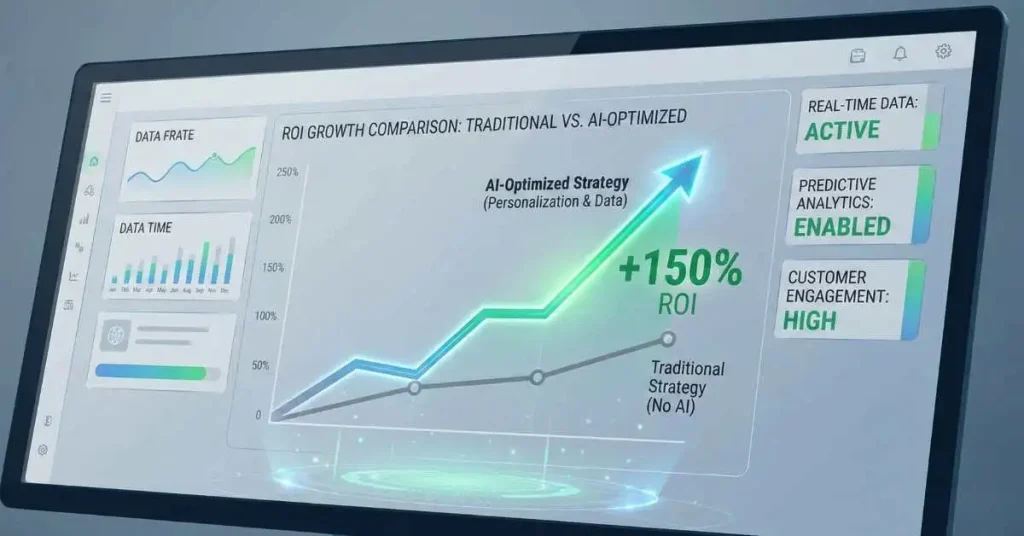
This stack is sufficient to execute, measure and optimize a marketing plan for ambitious sales managers without needing a team of 20 people.
7. The KPIs that matter: from vanity metric to business indicator
A CEO doesn’t need to know how many impressions the latest LinkedIn post got. He needs to know how much pipeline marketing generated last quarter and at what cost.
These are the four KPIs that should be on any business-oriented B2B marketing dashboard:
- CAC (Customer Acquisition Cost): total invested in marketing and sales divided by the number of new customers. If it goes up quarter by quarter without the LTV going up, there is a structural problem.
- LTV (Lifetime Value): total revenue generated by a customer during the entire relationship. The LTV:CAC ratio should be at least 3:1 in healthy B2B businesses.
- MQL → SQL conversion rate: how many marketing-qualified leads are converted into actual sales opportunities. Measuring this eliminates friction between the two teams.
- Pipeline generated by marketing: in euros. How much of the sales pipeline originates from marketing actions. This is the number that justifies (or questions) any budget.
Building this dashboard in Looker Studio connected to HubSpot and GA4 takes between 4 and 8 hours. What it gives in return is clarity on what works and what doesn’t, quarter by quarter.
8. The quarterly review: the plan as a live system
A B2B marketing plan is not a document that is delivered in January and filed away. It is a decision system that must be updated with real data every three months.
The quarterly review protocol that works in practice includes four specific questions:
- Which channel generated the most pipeline in proportion to investment? Duplicate there.
- Which channel consumed budget without generating qualified opportunities? Pause or reformulate.
- Has the ICP or market buying triggers changed? If there are signals (on sales calls, in the CRM, in organic searches), the message needs to change.
- What is the competition doing that we are not yet doing? Here AI is your greatest ally: a well-structured prompt can give you a competitive analysis in 20 minutes that used to take weeks.
Companies that review and adjust their marketing strategy every quarter grow consistently. Those that execute the previous year’s plan without question, decrementally.
Frequently asked questions about the B2B marketing plan
With the right framework and the support of AI tools for diagnostics and competitive analysis, a functional B2B marketing plan can be ready in 2 to 4 weeks. The common mistake is to spend months on planning and weeks on execution. It should be the other way around.
It depends on the average ticket and the sales cycle. For tickets over €5,000 and long sales cycles, LinkedIn combined with SEO and GEO content is the combination with the best ROI in the medium term. For immediate demand generation, Google Search Ads. For retention and nurturing, email marketing with automation.
AI in B2B marketing with artificial intelligence has three high-impact practical applications: time-sensitive market diagnostics and analytics, content generation and optimization at scale, and nurturing personalization based on lead behavior. It does not replace strategy; it accelerates it.
In B2B, the decision cycle is longer, multiple people are involved and content must respond to specific business needs, not emotional impulses. The acquisition budget per customer is higher, which justifies a higher investment in lead quality versus volume.
If you are building your B2Bmarketing strategy for 2026 and need to validate the diagnosis, define the ICP or structure the technology stack with tools like n8n, HubSpot or SE Ranking, we work on exactly that. Tell us where you are and we’ll tell you where you should be.

Marketing tecnológico en vena. Fanático de las tecnologías Martech que rompen moldes: IA generativa, blockchain, no-code, metaverso, automatización extrema… Convencido de que el futuro no se espera, se construye (y se vende muy bien).
Responsable del marketing más disruptivo y tecnológico.