
Using AI doesn't automatically mean it's profitable. Find out which processes help an SME make money with AI and automation, how to calculate ROI, and how to achieve it in a matter of weeks.

Using AI doesn't automatically mean it's profitable. Find out which processes help an SME make money with AI and automation, how to calculate ROI, and how to achieve it in a matter of weeks.

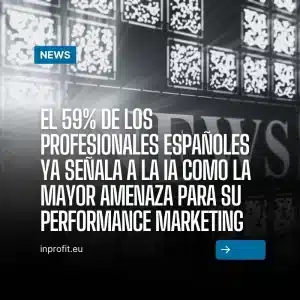
A study of 100 Spanish professionals identifies the loss of traffic caused by AI as the greatest risk to performance channels: 59% cite it as such, and 79% are already considering new channels. We analyze the data and propose 15 specific actions to adapt customer acquisition to this new era,...

AI-powered website builders can launch sites in a matter of hours, but WordPress remains the standard for projects built to last. The useful question isn’t which one is better, but at what exact point a website built with AI stops serving your needs. Five breaking points and five questions to...

AI no longer just writes text—it designs, structures, and optimizes entire websites to drive conversions. We'll show you how to use it effectively in your business.

Did you know that, according to a recent Forrester Analytics report projected by the end of 2026, 78% of leading brands already use autonomous AI agents to manage their visual consistency and tone of voice? If your brand is still relying exclusively on static PDF identity manuals, you're losing agility...

Using AI doesn't automatically mean it's profitable. Find out which processes help an SME make money with AI and automation, how to calculate ROI, and how to achieve it in a matter of weeks.
Did you know that by the end of 2025, 85% of companies that only “experimented” with isolated prompts failed to overcome the productivity valley? According to the Gartner 2026 trends report, the difference between market leaders and followers is no longer access to technology, but the systemic integration of artificial...

Imagine being able to know, at the exact moment a lead arrives in your CRM, not only their name and company, but also if they have just received a round of funding, if they have posted a job offer that your product solves, or if they have changed positions in...

There is an uncomfortable truth that many sales managers avoid acknowledging: the modern buyer knows more about his own problem than the average salesperson. Before a first call, they have researched solutions, compared prices, read reviews and possibly already have a short list of suppliers. In that context, coming up...

AI is not the future, it is the immediate present. Discover how a strategic consultancy in Artificial Intelligence can transform the processes of your SME or large company, eliminating inefficiencies and boosting profitability. It's not enough to use tools; you need a roadmap.
As technology and marketing become increasingly intertwined, a key concept emerges: “Martech”. This contraction of ‘marketing’ and ‘technology’ encapsulates the integration of technological tools into marketing strategies to optimize and improve the efficiency and effectiveness of advertising campaigns. Below, we will explore how the convergence of marketing, technology, strategy and Martech is redefining the digital marketing landscape and how companies can leverage these elements to gain a competitive advantage.
Marketing, at its core, has always sought to connect with the customer in the most effective and efficient way possible. With the evolution of digital technology, marketing strategies have evolved to adopt a number of tools that facilitate this objective. From marketing automation platforms to advanced data analytics and artificial intelligence solutions, technology has enabled marketers to personalize the user experience and improve the accuracy of their campaigns.
Implementing technology without a clear strategy is like navigating without a map; you may eventually reach your destination, but the road will be littered with inefficiencies and missed opportunities. Effective Martech strategy involves not only selecting the right tools but also integrating them in a way that aligns with the company’s long-term objectives. This means understanding the customer journey, personalizing interactions and automating processes at strategic points to optimize both customer acquisition and retention.
The implementation of an innovation laboratory in marketing and new technologies is essential to foster a culture of creativity and adaptation in all areas of the company. This space allows experimenting with emerging tools, such as artificial intelligence, big data or augmented reality, to develop more effective and personalized marketing strategies. By integrating these solutions, organizations can anticipate customer needs, optimize internal processes and improve data-driven decision making. Such a lab not only boosts the marketing area, but also generates a transversal impact by providing departments such as sales, operations or human resources with innovative tools that increase their efficiency and competitiveness.
On the other hand, an innovation lab acts as a catalyst for interdepartmental collaboration, breaking down silos and promoting a change-oriented mindset. By involving all areas of the company, from finance to production, it encourages the co-creation of solutions that address specific challenges and take advantage of market opportunities. For example, the use of technologies such as predictive analytics can help finance forecast revenue trends, while virtual reality can optimize human resources training processes. This integration ensures that innovation is not limited to marketing, but becomes a strategic pillar that permeates the entire organization, aligning objectives and maximizing results.
Finally, the adoption of an innovation lab positions the company as a leader in its industry, attracting talent and strengthening its brand image. In a business environment where digital transformation is key, having a space dedicated to exploring new technologies and methodologies ensures a sustainable competitive advantage. It also enables the company to respond quickly to changes in the market, adapting products, services and marketing campaigns to consumer expectations. This proactive approach not only enhances the customer experience, but also drives economic growth and organizational resilience, ensuring that all areas of the company are prepared to meet the challenges of the future.
From plan to ROI
Develop new sales, marketing, automation and AI strategies to lead the market.
© 2026 Inprofit Consulting S.L.
CIF: ESB4260505555
Alicante Office: Calle Primero de Mayo, 4 (Alcoy) | Valencia Office: Calle Colón, 4 (Valencia)