


93% of searches performed in Google AI Mode end up without a single click to any website. This is not a projection or a hypothesis: it is the Semrush data for September 2025. And if we add traditional searches, where AI Overviews already cover more than 60% of the total, the conclusion for any manager is uncomfortable but urgent: Google has ceased to be a traffic highway and has become a showcase. The question is no longer how to get more organic visits. The question is how to position your company so that this showcase works in your favor even if the user never reaches your website.
What are no-click searches and why the trend is getting worse
A no-click search – or zero-click search –is one in which the user gets an answer directly on the results page without the need to enter any website. For years, Google offered featured snippets and knowledge panels that already reduced traffic to websites. In 2026, AI Overviews have elevated that dynamic to a completely different scale.
The data is compelling. According to Searchlab, more than 80% of all Google searches in 2026 will end without a click. Queries that trigger an AI Overview register a zero-click rate of 83%. And the organic CTR of the first position drops by 58% on average when an AI-generated overview appears above the results.
For companies that have built their digital acquisition strategy on organic traffic, this is not background noise. It’s a structural change in the model.
Why Google is changing the rules and what it means for your business
The role of AI Overviews
Google launched AI Overviews in 2024 and rolled them out massively in 2025. They are AI-generated answer blocks that appear at the top of results before any organic link. Their stated goal is to give more complete answers in less time. The side effect – for website owners – is that the user already has what they were looking for before they see any results.
What many companies haven’t yet processed: Google doesn’t always cite the one that ranks best, but the one that responds best. Sources mentioned in AI Overviews receive 35% more clicks than equivalent results that don’t appear in those responses, according to Gartner data. Being cited by AI is, in 2026, more valuable than ranking first organically.
AI mode: the next level of the problem
Google AI Mode -still in progressive deployment- is a conversational search interface where the user dialogues directly with an AI system. In this environment, 93% of interactions do not generate any external clicks. This is not because the user does not want information, but because the AI gives complete answers, including follow-ups, without the need to leave Google.
Gartner forecasts a 25% drop in traffic from search engines by the end of 2026. Not for all companies equally, but for those that do not adjust their strategy.
What is really at stake
Translated into business-speak: if your company relies on organic traffic as a primary acquisition channel, you’re looking at a progressive reduction in leads and opportunities that isn’t going to reverse. Referral traffic from AI is growing 527% year over year, according to 2025 data – but that traffic is going to those who appear in responses, not those who simply post content.
The real risk scenario is not that your website disappears from Google. It is that Google continues to exist, your website continues to be indexed, and yet your potential customers receive complete answers about your services, your competitors and market solutions without your company being mentioned in any of them.
The dual strategy you need right now
Abandoning SEO would be a mistake. Continuing to do only traditional SEO would also be a mistake. The answer is a double strategy: authority SEO + GEO (Generative Engine Optimization).
Authority SEO: remaining the source Google wants to cite
AI systems do not invent answers: they extract them from sources they consider reliable. That means SEO is still relevant, but the goal has changed. It’s no longer about getting clicks; it’s about becoming the source that language models use to generate their answers.
To do so, the content must have three specific characteristics. First, factual density: proprietary data, verifiable figures, internal studies or industry analysis that AI models cannot find elsewhere. Second, direct and self-contained answers: paragraphs that answer a specific question in the first two or three lines, without preambles. Third, periodic updating: AI systems prioritize fresh content when the topic is dynamic. A 2022 article on artificial intelligence is no longer a reference source.
GEO: appearing in AI responses
GEO or Generative Engine Optimization is the discipline that optimizes content and digital presence to be cited by ChatGPT, Gemini, Perplexity and Google’s AI Overviews. It is not SEO by another name; it is an additional layer with its own rules.
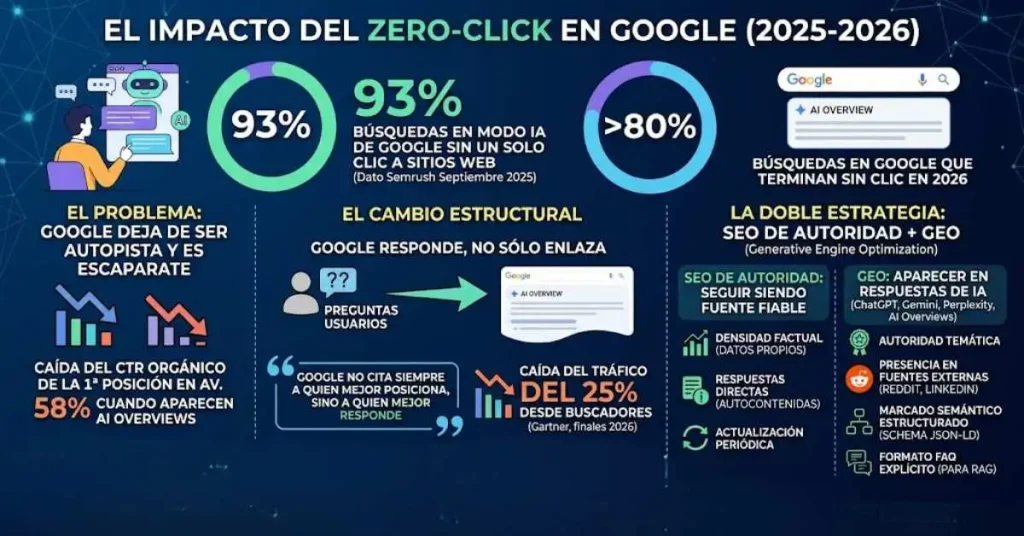
The factors that most influence whether or not a company appears in AI-generated responses are as follows:
- Consolidated subject authority: models prioritize sources that cover a topic with depth and consistency, not sites with scattered content. Publishing 40 articles on a particular niche beats having 200 articles on a variety of topics.
- Presence in external sources: AI systems crawl Reddit, LinkedIn, trade publications, industry forums and review platforms. Having your brand mentioned positively in these sources increases your likelihood of being cited.
- Structured semantic markup: the use of Schema Markup (JSON-LD) for articles, FAQs, organization and products makes it easy for models to extract and interpret your information unambiguously.
- Explicit FAQ format: well-structured question and answer sections are the preferred format for RAG (Retrieval Augmented Generation) pipelines that feed models. A FAQ section at the end of each blog article is not an ornament: it is a lever of visibility in AI.
Five concrete actions to start this week
Talking strategy is easy. The difficulty lies in execution when teams already have a full day. These are the five actions with the highest impact/effort ratio for companies starting from a standard SEO base:
- Audit which of your pages already appear in AI Overviews by searching in Google for the keywords you are interested in from Spain. If you do not appear, analyze which sources do appear and why.
- Rewrite the first paragraphs of your top ten articles so that they answer the main question in the first 100 words. No introduction. No prior context. Direct answer.
- Add a FAQ section with Schema at the end of each new article you publish. Minimum three questions. Answers of no more than three sentences each.
- Generate your own data asset: a customer survey, an internal study, an analysis of your industry. Original data is the most valuable currency in the generative AI ecosystem.
- Build active presence on LinkedIn at the company and key management level. AI models crawl LinkedIn as a source of industry authority. Publishing a weekly analysis of industry trends is not just branding: it signals authority to the systems that decide who to cite.
The channel that doesn’t disappear: the one you control
There is a strategic consequence of zero-click that marketing teams often overlook: the traffic that does hold up is from your own audience. Mailing lists, customer communities, LinkedIn groups, newsletter subscribers. These are channels where no algorithm can stand between your content and your audience.
The most resilient companies in the face of zero-click are not necessarily the ones that rank better on Google. They are the ones that have a strong enough audience base of their own to not rely on Google as their sole acquisition channel. Reducing that dependency is not a defensive option: it is the most offensive decision a marketing team can make in 2026.
Frequently asked questions about click-free searches
A Google search in which the user gets the answer directly on the results page, without clicking through to any website. It occurs when Google displays an AI Overview, featured snippet, knowledge panel or other element that satisfies the query without leaving the search engine.
No. SEO is still relevant, but its purpose has changed. Instead of optimizing just to get clicks, you have to optimize to be cited as a source in AI responses. Companies that appear in AI Overviews get more quality traffic, not less.
GEO or Generative Engine Optimization is the discipline that optimizes digital presence to appear in responses generated by AI systems such as ChatGPT, Gemini, Perplexity or Google’s AI Overviews. SEO works to rank in results listings; GEO works to be the source that the AI cites when it generates its answers.
It depends on the industry and the type of searches that generate your traffic. Gartner estimates an average 25% drop in search engine traffic by the end of 2026. Companies in sectors with many informational searches (health, finance, technology, legal) are the most exposed.
Check Google Search Console to see if the number of impressions is growing but clicks are stagnating or dropping. That pattern – more visibility, less traffic – is the clearest sign that AI Overviews are absorbing searches that used to generate visits for you.
If your company needs to build a visibility strategy that works in today’s environment, both in search engines and in generative AI systems, we can help you generate it.

Especialista en SEO y Paid Media | Google Ads, Meta Ads, LinkedIn Ads & Search Console en vena Optimizo visibilidad orgánica + escalo adquisición pagada con ROAS obsesivo y estrategias data-driven.
Especialista en Performance Digital, Core Web Vitals, E-E-A-T, algoritmos de subasta, attribution multi-touch y maximizar LTV/CAC.